





AAS Deputy CEO: Vietnam’s Stock Market in 2026 to See Deep Growth with Strong Sector and Stock Differentiation


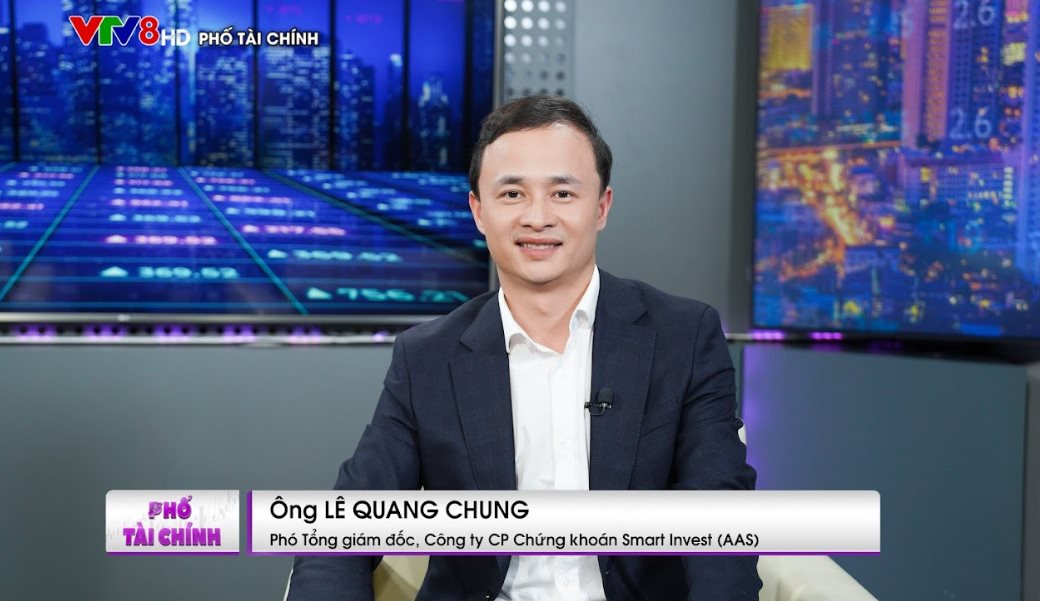
In the early days of the 2026 calendar year, Vietnam’s economy and stock market have continued to receive positive signals. Notably, the Politburo’s Resolution No. 79 on the development of the state-owned economic sector has been issued, reaffirming that the state sector will not only serve as a “pillar” of the economy, but also play a leading and growth-creating role in the new development phase.
In 2026, Vietnam’s stock market is also expected to be officially upgraded according to FTSE’s previous announcement. Combined with other positive factors, how is the stock market outlook shaped, and what would be an effective overarching strategy for 2026?
Speaking on The Finance Street talk show on VTV8, experts believe that with favorable macroeconomic conditions and the anticipated market upgrade, Vietnam’s stock market is set for a promising year in 2026.
Vietnam recorded economic growth of over 8% in 2025. With the 2026 target aiming for double-digit growth, slightly higher but controlled inflation, how do you assess this goal?
Mr. Le Quang Chung, Deputy CEO, Smart Invest Securities JSC (AAS):
In my view, the double-digit growth target for 2026 is certainly ambitious, but it is not without a solid foundation. Notably, Vietnam achieved economic growth exceeding 8% in 2025. To reach the stated target, several key drivers must be in place.
First, the policy framework has become clearer and more decisive. Recent major resolutions, particularly Resolution No. 79, emphasize a focus on key state-owned enterprises. We can see that policy execution is becoming more resolute and efficient, while longstanding bottlenecks are being actively addressed, creating a strong foundation for economic acceleration in the coming period.
Second, public investment will undoubtedly remain a core pillar of economic growth. In 2026, public investment disbursement is expected to accelerate significantly, acting as a major growth driver for the economy.
Third, export activities are expected to continue growing in 2026, supported by the ongoing recovery of the global economy. The U.S. Federal Reserve has entered an interest rate cut cycle, while improving demand from the U.S. and EU will support Vietnam’s key export sectors.
After six months of tariff implementation, U.S. imports from Southeast Asia rose by 25% in Q3 2025, equivalent to an additional USD 40 billion. Vietnam accounted for the largest share of this increase, approximately USD 18 billion—nearly half of the total. Meanwhile, U.S. imports from China declined by 40% in the same period, clearly indicating a restructuring of supply chains driven by tariff policies. These data suggest that the production shift toward Vietnam will accelerate further.
Fourth, domestic consumption stability is a crucial factor. As incomes gradually recover and consumer sentiment improves compared to the 2023–2024 period, domestic consumption will become an internal growth engine. Moreover, if public investment disbursement improves materially, the spillover effects on construction, materials, logistics, and consumption will be substantial.
Alongside these growth drivers, we must also acknowledge challenges and risks. First, the high comparison base of 2025 may make it difficult for 2026 growth to accelerate sharply without new momentum. Second, monetary policy space is narrowing as inflation edges higher. The State Bank of Vietnam plans credit growth of around 15%, while GDP growth is targeted at 10%. Historically, achieving 10% GDP growth requires credit growth of 20–23%, making credit constraints a potential challenge. Third, external risks remain, including trade protectionism, supply chain volatility, and geopolitical uncertainties.
The stock market has shown positive momentum at the start of the year, with stronger liquidity and broader capital flows across stocks rather than concentration in a few names. How do you assess this development?
Mr. Le Quang Chung:
At the beginning of 2026, the market experienced several positive trading sessions. Rising capital inflows reflect favorable seasonal factors, as funds tend to return early in the year. The recovery starting in January also signals the return of speculative capital after four months of declining liquidity.
Another factor is renewed investor expectations. Investors are beginning to “price in” 2026 narratives such as stronger economic growth, market upgrading, and improved corporate earnings. In particular, BlackRock—the world’s largest asset manager—has published analyses expressing optimism toward markets such as China, Mexico, and Vietnam, further supporting investor sentiment.
More importantly, the strong capital dispersion observed in early 2026 indicates a healthier market structure. Capital is no longer concentrated solely in a few large-cap stocks, but is spreading across multiple sectors. This suggests a more sustainable uptrend, less dependent on a single leadership group, and helps reduce the risk of “overheated rallies followed by sharp corrections.” Structurally, this is a positive signal reflecting gradually strengthening investor confidence.
Based on these analyses, how do you expect the stock market to perform in 2026?
Mr. Le Quang Chung:
In my view, 2026 will be a year of strong differentiation, with selective and focused growth rather than a broad-based rally.
Supportive factors include stronger economic growth improving corporate profitability, expectations of market upgrading attracting medium- and long-term foreign capital, and a relatively stable interest rate environment supporting equity valuations.
However, several risks remain, including global uncertainties related to geopolitics and international monetary policies. In addition, the Vietnamese market still needs more diversified and high-quality products—such as ETFs, expanded derivatives, and more transparent corporate bonds—to attract large-scale, long-term capital.
Overall, 2026 is likely to be a year of “deep growth,” characterized by strong differentiation across sectors and individual companies, rather than a generalized market surge.
In this context, what strategies should investors and institutions adopt in 2026?
Mr. Le Quang Chung:
For individual investors, medium- and long-term strategies should be prioritized, while trading exposure can be increased selectively during suitable periods.
There are three key considerations. First, strong market differentiation and volatility on both the upside and downside require greater flexibility. Second, investors should favor a bottom-up stock selection approach rather than a top-down strategy, given the high level of differentiation. Third, priority should be given to large-cap companies and those benefiting from major economic reforms, export growth, public investment, and institutional improvements.
Short-term trading opportunities still exist, but they demand strict discipline and experience. For institutional investors and securities firms, AAS research suggests focusing on three pillars: in-depth investment advisory services, long-term asset management, and the development of new products aligned with a market upgrade, while accompanying investors throughout their journey.
Which sectors do you see as having strong potential in 2026?
Mr. Le Quang Chung:
Based on AAS research, several sectors stand out. First, state-owned enterprises and infrastructure companies, which benefit from major resolutions, public investment, and restructuring. Second, banking, which gains from credit growth, though careful selection of banks with strong asset quality is essential. Third, securities firms, benefiting from improved market liquidity and the market upgrade narrative. Fourth, industrial, export, and logistics sectors, supported by the global trade recovery cycle.
That said, investors should not focus solely on sectors. More importantly, each investment decision should be based on whether a company meets both necessary and sufficient conditions: transparent governance, a clear growth strategy, and direct benefits from policy support or long-term trends. In my opinion, 2026 is not a year to “buy the entire market,” but a year to choose the right companies, the right stories, and the right cycles.
Special offers for customers opening new accounts at AAS
The Portfolio Ratio Selling feature of Smartsell is suitable for customers needing to quickly sell securities.
More
Quan tâm nhiều

AAS News
-

🔴LIVESTREAM: MARKET OVERVIEW | 25.11.2025 | M2 MONEY SUPPLY – THE KEY TO WELCOME A NEW WAVE
AAS News
-
AAS Deputy CEO: Vietnam’s Stock Market in 2026 to See Deep Growth with Strong Sector and Stock Differentiation

AAS News
-
🔴 LIVESTREAM: AAS & VIETSTOCK | YEAR-END WAVES: STOCK TRADING, REAL ESTATE HOLDING, OR GOLD SAVING?

AAS News
-
?? AAS ANNOUNCES 2024 NEW YEAR’S DAY HOLIDAY SCHEDULE
Related Articles

At AAS, the spirit of discipline, perseverance, and teamwork is not only reflected in our work, but is also vividly present on the sports field. On December 27, AASPICK CUP 2025 – the first internal Pickleball tournament of AAS – took place with countless memorable moments: intense rallies, explosive scoring shots, smiles after each match, […]


Dear Valued Customers, Smart Invest Securities Joint Stock Company (AAS) would like to respectfully inform our valued customers of the trading holiday schedule for the New Year 2026 as follows: Trading holiday: From Thursday, January 1, 2026 to the end of Friday, January 2, 2026 Trading resumes: From Monday, January 5, 2026 On the […]

AAS would like to extend to our Valued Clients our warmest wishes for good health, peace of mind, and sustainable financial growth in the year ahead. 🌟 Merry Christmas & Happy New Year 2026 🌟

Market Panorama Livestream: Money Supply M2 – The Key to Welcoming a New Wave ⏰ Time: 11:00 AM, November 25, 2025🎥 Livestream on: AAS Smart Invest Securities Fanpage, YouTube, TikTok & FireAnt——————————————————————— 👉 Join the minigame “Ask Great Questions – Win Great Gifts” during the livestream for a chance to receive: 🎁 01 Insightful Viewer […]

Before every major wave of the VN-Index, the market always gives early signals. This time, it’s M2, an important liquidity measure, which is silently providing momentum for the stock market. According to the most recent report by Governor of the State Bank of Vietnam, Nguyễn Thị Hồng, on money supply M2: “In the first 7 […]